Introduction
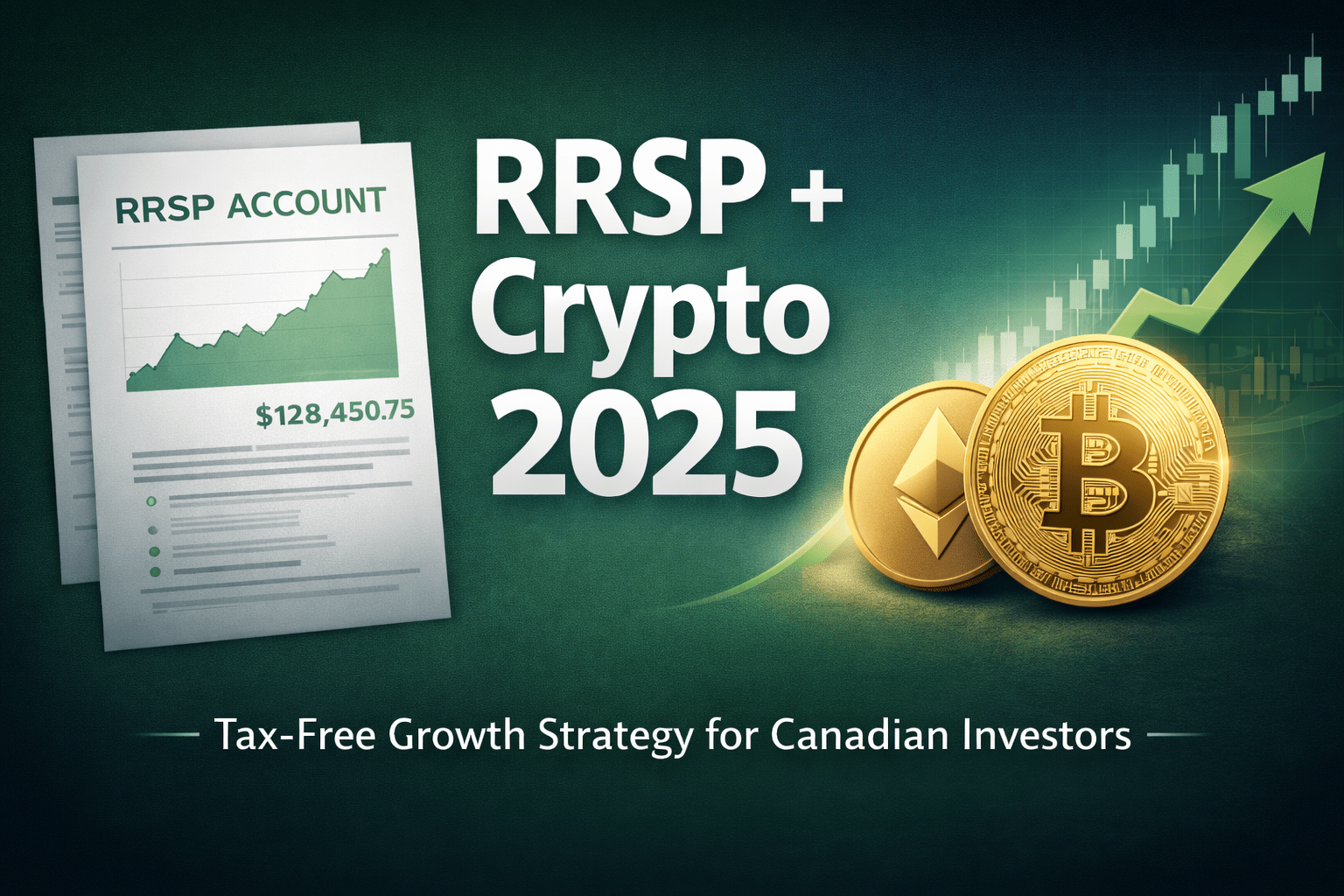
For Canadian cryptocurrency investors, the RRSP (Registered Retirement Savings Plan) represents one of the most powerful tax optimization tools available—but most people don’t know they can use it to hold Bitcoin, Ethereum, and other cryptocurrencies. According to CRA guidelines on RRSP-eligible investments, certain cryptocurrencies are permissible, meaning you can build a crypto portfolio inside a tax-deferred account. This changes the game for long-term investors. Instead of paying capital gains tax annually on trades, you can hold, trade, and compound your crypto wealth tax-free until retirement. This guide explains exactly which cryptocurrencies you can hold in an RRSP, which you cannot, how to set it up, and the strategic advantages that make this approach superior to holding crypto in non-registered accounts.
What CAN Be Held in an RRSP
The CRA is strict about RRSP-eligible investments. Not all crypto qualifies.
Eligible Cryptocurrencies:
- Bitcoin – Explicitly permitted
- Ethereum – Explicitly permitted
- Major stablecoins (USDC, USDT) – Permitted, but check with your provider
- Crypto ETFs – Permitted (easier and often recommended)
- Purpose Bitcoin ETF (TSX: BTC)
- Grayscale Bitcoin Trust (TSX: BTC.U)
- 3iQ CoinShares Bitcoin ETF (TSX: XBT)
- Ethereum ETFs (Purpose Ethereum ETF, 3iQ CoinShares Ethereum ETF)
Why ETFs are often easier:
- They’re held through your RRSP provider directly (no custody concerns)
- Your provider handles tax reporting
- No confusion about what’s eligible
- Professional custody and insurance
Example RRSP-eligible holdings:
- Self-directed RRSP account at Questrade holding Bitcoin and Ethereum directly
- RRSP at Interactive Brokers holding Purpose Bitcoin ETF
- RRSP at TD Direct Investing holding crypto ETFs
- RRSP at National Bank Direct Brokerage holding Bitcoin/Ethereum
What CANNOT Be Held in an RRSP
This is critical. The CRA disallows certain crypto activities inside RRSPs. Getting this wrong can result in the CRA deregistering your entire account, triggering immediate taxation on all holdings.
Not Permitted:
- Staking rewards – Your RRSP cannot participate in proof-of-stake networks (Ethereum 2.0 staking is prohibited)
- DeFi lending or yield farming – Yield Generation Protocols are not permitted
- Altcoins (Cardano, Polkadot, Solana, etc.) – Only Bitcoin and Ethereum are explicitly approved
- Privacy coins (Monero, Zcash) – Explicitly banned
- Margin trading or leverage – Your account could be deregistered
- Non-custodial wallets – You cannot hold the private keys to crypto in an RRSP (you must use a custodian)
- Borrowed capital – You cannot borrow money to buy crypto inside an RRSP
Why the restrictions? The CRA views speculative activity and yield generation as inconsistent with retirement savings. RRSPs are meant for long-term, buy-and-hold investing—not active trading.
The danger: If you stake ETH inside an RRSP, the CRA can deregister your account. You’d then owe tax on the entire balance as if you withdrew it all, plus penalties and interest. One staking reward could cost you tens of thousands in taxes.
Why Tax-Deferred Growth Matters
Let’s look at the math. Canada taxes capital gains at a 50% inclusion rate, meaning 50% of your gains are taxable.
Scenario: $10,000 Bitcoin investment over 10 years
Non-registered account (taxed annually):
- Initial investment: $10,000
- Growth to: $50,000
- Capital gain: $40,000
- Taxable gain (50%): $20,000
- Tax owed (at 43.4% marginal rate in Ontario): $8,680
- After-tax value: $41,320
RRSP account (tax-deferred):
- Initial investment: $10,000
- Growth to: $50,000
- Tax deferred until withdrawal in retirement
- If you withdraw in retirement at lower tax bracket (20% marginal rate): $2,000 tax owed
- After-tax value: $48,000
Difference: $6,680 more in your pocket by using an RRSP.
And that’s only if you hold for 10 years without trading. If you actively trade, the advantage grows exponentially because each trade in the RRSP doesn’t trigger a capital gains tax—it’s all deferred.
How to Set Up a Crypto RRSP
There are two main approaches:
Option 1: Self-Directed RRSP (Direct Crypto Holdings)
What it is: You hold Bitcoin/Ethereum directly in a custodian-managed account within an RRSP.
How to set up:
- Open a self-directed RRSP at:
- Questrade – Excellent for crypto (low fees, direct BTC/ETH holdings)
- Interactive Brokers – Advanced traders (more complex)
- Coinbase Prime – Crypto-native custody (new option)
- Make a contribution:
- Calculate your RRSP contribution limit (18% of prior year income, max $31,560 in 2025)
- Transfer funds from your bank account
- Claim the RRSP deduction on your tax return
- Buy Bitcoin/Ethereum:
- Use the account’s trading interface
- Your custodian holds the coins in segregated, insured wallets
- You don’t control the private keys (regulatory requirement)
- Hold and compound:
- All trades and gains are tax-deferred
- Keep the account active for 40+ years if desired
Pros:
- Direct ownership of Bitcoin/Ethereum
- Potential for higher returns (vs. ETFs)
- Full control over buy/sell decisions
Cons:
- Higher fees (typically 0.5–1% annually)
- Requires more active management
- Custody risk (though insured)
- Non-custodial wallets not permitted
Option 2: Crypto ETF Strategy (Easier Path)
What it is: You hold Bitcoin/Ethereum through regulated ETFs inside your RRSP.
How to set up:
- Open an RRSP at any major Canadian broker:
- Make your RRSP contribution (see above)
- Buy crypto ETFs:
- Hold:
- All dividends/distributions are reinvested tax-free
- No custody concerns
- Automatic tax reporting (T-slips)
Pros:
- Easy to set up (works at any broker)
- Lower fees (0.4–0.6% management fees)
- Professional custody and insurance
- T-slips automatically generated for tax filing
- No private key management concerns
- Easier to understand for regulatory compliance
Cons:
- Slight tracking error (ETFs don’t perfectly mirror crypto prices)
- You’re not directly holding Bitcoin/Ethereum
- Less potential upside vs. direct holdings (same downside though)
Recommendation: If you want simplicity and regulatory certainty, use crypto ETFs. If you’re comfortable with custody and want direct control, self-directed crypto is fine—just ensure your custodian is insured and regulated.
RRSP Contribution Limits & Tax Deductions
According to CRA RRSP contribution rules:
2025 Limits:
- Contribution limit: 18% of previous year’s income, maximum $31,560
- Deadline: March 1, 2026 (for 2025 tax year)
- Carry-forward room: Unused contributions accumulate indefinitely
Example:
- You earned $100,000 in 2024
- Your 2025 RRSP limit = $18,000
- You contribute $18,000 to your RRSP in crypto (BTC/ETH)
- You claim a $18,000 RRSP deduction on your 2025 tax return
- Tax savings (at 43.4% rate): $7,812
That $7,812 tax saving can be reinvested into your RRSP immediately, creating a compounding effect.
Home Buyers’ Plan Strategy
One of the most powerful RRSP strategies for younger Canadians is the Home Buyers’ Plan (HBP).
How it works:
- First-time homebuyers can withdraw up to $35,000 from their RRSP tax-free
- Requirement: Must repay the amount over 15 years
- Benefit: No immediate tax on the withdrawal
Strategy for crypto investors:
- Buy $35,000 of Bitcoin in your RRSP
- Hold for 3–5 years
- If Bitcoin grows to $100,000, you can withdraw it tax-free for your home down payment
- Repay $2,333/year for 15 years (you keep all the gains)
Example:
- You’re 28 years old, first-time buyer
- Contribute $35,000 to RRSP as Bitcoin
- Bitcoin grows to $120,000 over 5 years
- You buy your first home and use HBP to withdraw $120,000 (limit increased if you contributed more)
- You keep $85,000 in gains tax-free
- Repay $8,000/year for 15 years
This is a legitimate strategy that CRA explicitly allows.
Low-Income Year Withdrawal Optimization
If you have a year with significantly lower income (sabbatical, job transition, retirement), you can strategically withdraw RRSP funds and pay minimal tax.
Example:
- You take a sabbatical in 2025 (no income)
- Your RRSP has $200,000 in Bitcoin
- You withdraw $50,000—taxed at your marginal rate: ~0% (because your income is zero)
- The rest stays in the RRSP, continuing to compound tax-free
This is legal and strategic. Many investors plan their careers around low-income years specifically to optimize RRSP withdrawals.
Spousal RRSP Income Splitting Tactics
Spousal RRSPs are one of the best-kept secrets in Canadian tax planning. Per CRA spousal RRSP rules:
How it works:
- Higher-earning spouse contributes to spouse’s RRSP (not their own)
- Contribution room comes from higher earner’s limit
- Tax deduction goes to higher earner
- But the money grows in spouse’s account
- At withdrawal in retirement, spouse pays tax at their (hopefully lower) rate
Example:
- You earn $150,000 (43.4% tax bracket)
- Your spouse earns $40,000 (20% tax bracket)
- You contribute $15,000 to spouse’s RRSP (using your contribution room)
- You claim $15,000 deduction (save $6,510 in tax)
- Spouse’s RRSP grows to $80,000
- At retirement, spouse withdraws at 20% tax rate (not your 43.4%)
- Tax savings: ~$18,000 over the account’s lifetime
With crypto: A high-earning spouse can fund a lower-earning spouse’s RRSP with Bitcoin, getting an immediate tax deduction while shifting future investment gains to the lower-income spouse.
This is completely legal and explicitly permitted by CRA.
RRSP vs. TFSA for Crypto Investing
The TFSA (Tax-Free Savings Account) is another registered account. Which is better for crypto?
TFSA Advantages:
- Tax-free withdrawals anytime
- Withdrawn room returns next year
- No restrictions on activity (staking, lending, trading)
- 2025 limit: $7,000/year
- If you need funds before retirement, TFSA is better
RRSP Advantages:
- Higher contribution room (18% of income, $31,560 limit)
- Immediate tax deduction
- Spousal strategies available
- Home Buyers’ Plan ($35,000 tax-free withdrawal)
Recommendation:
- Aggressive savers: Max RRSP first (higher deduction value), then TFSA
- Younger investors: TFSA first (more flexibility if you need funds)
- High-income earners: RRSP (higher tax bracket = higher savings)
- Active traders: TFSA (no worries about deregistration)
Strategic Multi-Account Allocation
The optimal strategy combines multiple accounts:
Example for a 35-year-old earning $100,000:
- RRSP (Self-Directed Bitcoin): $15,000/year
- Purpose: Tax-deferred long-term growth
- Strategy: Buy-and-hold Bitcoin, no trading
- Time horizon: 30 years until retirement
- TFSA (Crypto ETFs): $7,000/year
- Purpose: Flexibility + tax-free growth
- Strategy: Diversified BTC/ETH mix, can withdraw anytime
- Time horizon: Flexible
- Non-Registered (Active Trading Account): $5,000/year
- Purpose: Tactical trades and experimentation
- Strategy: Tax-loss harvesting, DeFi yields (taxable)
- Time horizon: Active management
10-year projection:
- RRSP: $150,000 contributed (compounded tax-free)
- TFSA: $70,000 contributed (compounded tax-free)
- Non-registered: $50,000 contributed (taxable, but loss harvesting offsets gains)
- Total crypto allocation: $270,000 across three accounts with different tax efficiency
This diversification ensures:
- Long-term tax-deferred growth (RRSP)
- Accessible funds for emergencies (TFSA)
- Flexibility for active strategies (non-registered)
What You CANNOT Do in an RRSP
This is the danger zone. Violating these rules can deregister your entire account:
- Staking Ethereum or other proof-of-stake coins ✗
- The rewards are active yield generation (prohibited)
- CRA explicitly disallows this
- Lending crypto through DeFi platforms ✗
- Even if returns are small, active yield generation is prohibited
- Margin trading or leverage ✗
- Borrowing money to buy crypto inside an RRSP is prohibited
- The CRA treats this as using borrowed capital for investment
- Self-directed custody (holding private keys) ✗
- You cannot hold Bitcoin in a hardware wallet inside an RRSP
- Your custodian must hold and insure the coins
- Non-custodial = RRSP deregistration
- Trading altcoins ✗
- Only Bitcoin and Ethereum are explicitly approved
- Cardano, Solana, Polkadot, etc. are prohibited
- Stablecoins are murky (stick with major, regulated ones like USDC)
- Holding restricted coins ✗
- Privacy coins (Monero, Zcash) are explicitly banned
- CRA considers these high-risk
The penalty: If the CRA discovers violations, your RRSP loses its registered status. You immediately owe tax on the entire balance as if you withdrew it all, plus penalties and interest. A $200,000 RRSP could result in $150,000+ in tax owing.
Common Mistakes Ottawa Investors Make
- Assuming all crypto is RRSP-eligible
- Only Bitcoin, Ethereum, and approved ETFs work. One staking reward can deregister your account.
- Holding in a non-custodian wallet
- You cannot hold Bitcoin keys in your own hardware wallet inside an RRSP. Use a regulated custodian.
- Not maximizing spousal RRSP strategy
- If one spouse earns significantly more, using spousal RRSP can save tens of thousands over 30 years.
- Over-funding RRSP and missing TFSA opportunity
- TFSA is more flexible. Don’t neglect it just because RRSP has bigger limits.
- Forgetting about the Home Buyers’ Plan
- If you’re a first-time buyer, $35,000 of tax-free withdrawal is valuable for down payments.
- Not rebalancing across accounts
- As you age, move from high-growth (Bitcoin) in RRSP to stable assets in TFSA.
RRSP vs. Corporate Cryptocurrency Holding
Some crypto investors ask: “Should I incorporate and hold crypto in my corporation?”
Corporate advantages:
- Tax deferral (corporate tax rates ~26% vs. personal rates ~43%)
- Retained earnings can be reinvested
- Possible estate planning benefits
Corporate disadvantages:
- Complexity and cost ($800–$2,000/year accounting)
- Capital gains tax on corporate level (same 50% inclusion rate)
- Distributions to you are taxed again (double taxation)
- CRA scrutiny on crypto-holding corps
Bottom line: For most individual investors under $500,000, RRSP + TFSA + non-registered is simpler and equally tax-efficient. Corporate structures are for active business operators, not buy-and-hold crypto investors.
Conclusion
RRSPs represent one of the most powerful tools Canadian crypto investors can use. By holding Bitcoin and Ethereum in a tax-deferred account, you’re avoiding capital gains taxation on trades, compounding your wealth at the full rate of return, and building a retirement account that can grow to seven or eight figures without annual tax drag.
The key is understanding the restrictions: only Bitcoin, Ethereum, and approved ETFs; no staking or DeFi; custodian-held coins only. One violation can cost you dearly, but adhering to the rules is straightforward.
Whether you’re 25 and just starting, or 55 and catching up, an RRSP crypto strategy should be part of your long-term plan. Combined with TFSA and strategic non-registered accounts, you can build a diversified, tax-optimized portfolio that works for decades.
If you’re unsure about your setup, have a complex situation (spousal RRSPs, high income, business ownership), or need help with allocation strategy, consult a tax professional in Ottawa who specializes in crypto. The investment in professional advice often pays for itself many times over through tax optimization.
Sources & References
Official CRA RRSP Resources:
- CRA – RRSP Overview
- CRA – What Kinds of Property Can You Hold in an RRSP
- CRA – Contributing to an RRSP
- CRA – Home Buyers’ Plan
- CRA – Spousal RRSPs
Capital Gains & Tax Rules:
TFSA Resources:
Business & Corporate Structure:
Canadian Crypto ETFs:
- Purpose Bitcoin ETF (TSX: BTC)
- 3iQ CoinShares Bitcoin ETF (TSX: XBT)
- Purpose Ethereum ETF (TSX: ETH)
- Grayscale Bitcoin Mini Trust (TSX: BTC.U)
RRSP Brokers & Custodians:
- Questrade – Self-Directed RRSP with Crypto
- Interactive Brokers
- Coinbase Prime – Institutional Custody
- TD Direct Investing
- RBC Direct Investing
- National Bank Direct Brokerage
Educational Resources:
Khaled (Kal) Hawari is a finance and accounting expert based in Ottawa specializing in cryptocurrency taxation, digital currency reporting, and tax optimization for Canadian residents. For personalized guidance on your crypto tax situation, schedule a consultation or be sure to do so via my Google Business Profile.